
Playful Preschool Curriculum
Math Begins in the Hands. Not on the Page.
Before your child ever sees a number on a worksheet, they need to feel what that number means. That is how we teach it.
My child hates math." We hear this from parents of 6-year-olds. It should never start that early.
It starts that early when math is introduced as symbols before it is understood as quantity. A child staring at “4 + 3 = 7” with no physical reference for what any of those numbers actually represent is not learning math. They are memorising a code they do not understand yet.
We start differently. And the difference shows up for years.
This Is What Your Child Actually Works With
A Child Who Understands Math Early Carries That Confidence Into Every Grade That Follows.
Spots for the current term are limited. Come see a maths lesson in person before you decide. It will answer every question this page could not.
- Montesori Playcare | 20 Greenwood Ave, Darien, CT 06820
- (203) 829-7769 | info@montessoriplaycarect.com
How a Child Moves Through Montessori Math
Symbol introduction
Sandpaper Numbers introduce the written form only after the child already knows what each quantity feels like.
Connecting the two
Number cards are matched to physical quantities. The symbol and the amount meet for the first time. The child makes the connection themselves.
Operations with material
Addition, subtraction, multiplication, and division are all performed with the Golden Bead material before pencil and paper enters the picture.
Quantity without symbols
The child handles Number Rods and counts physically before any numeral is shown.
The Moment It Clicks
Picture a 4-year-old carrying a tray with a thousand-bead cube to her mat. She sets it down carefully, looks at it, picks up a single bead, and places the two side by side.
She just understood the difference between 1 and 1000 without anyone explaining it. That understanding does not come from being told. It comes from holding both in her hands at the same time. That is a maths lesson that stays.
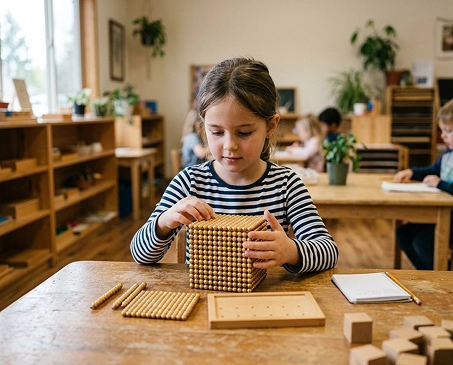
The Moment It Clicks
They count everything
Steps. Grapes. Cars in the parking lot. Counting becomes a habit, not a task.
They stop guessing
Children who understand quantity check their work naturally. They want to know if they are right.
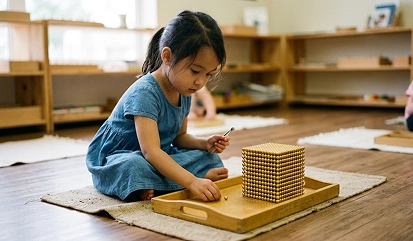
They are not scared of big numbers
A child who has held a thousand-bead cube is not intimidated by the number 1000. They have met it before.
They ask harder questions
"How many is a million?" That question comes from a child whose curiosity about number has been opened, not closed.
What Parents Usually Ask Us
No. We begin with quantity, not symbols. A child with zero prior number knowledge is exactly who this program is designed for.
Most preschools introduce numerals first and quantity second, if at all. We reverse that. The result is a child who understands what they are doing, not just what to write.
The Montessori math sequence is deep. There is always a next level. A child who moves fast simply moves further, not faster through the same material.alia and Consonantia, there live the blind texts. Separated they live in Bookmarksgrove right at the coast
Most children encounter it between 4 and 5, after they have solid quantity and symbol foundations. We introduce it when the child is ready, not when the calendar says so.
It prepares them well beyond kindergarten math. Children leaving our program typically enter elementary school already comfortable with four-operation concepts that most curricula introduce in first or second grade.
